
Lee County Arrest Records and Charges
Lee County arrest records may begin with a law-enforcement event, a magistrate order, an arrest warrant, or a booking at the Lee County Detention Facility. The court charge record is narrower and more formal. It identifies the accusation filed after arrest or criminal process, including defendant name, offense description, statute, offense class, charging agency or officer, warrant or citation number, bond, and the next court event when those fields are public.
The booking and custody side belongs with the Sheriff and jail. The court-charge side belongs with the Clerk of Superior Court and the statewide court system. For custody status and the jail grid, use Lee County inmate records. For the complete case history, outcome, sentence, and disposition, use Lee County criminal court records. The focus here is the path from arrest records to charges filed after arrest.
The official Lee County Sheriff's Office source page is one assigned source image for arrest records and law-enforcement routing.
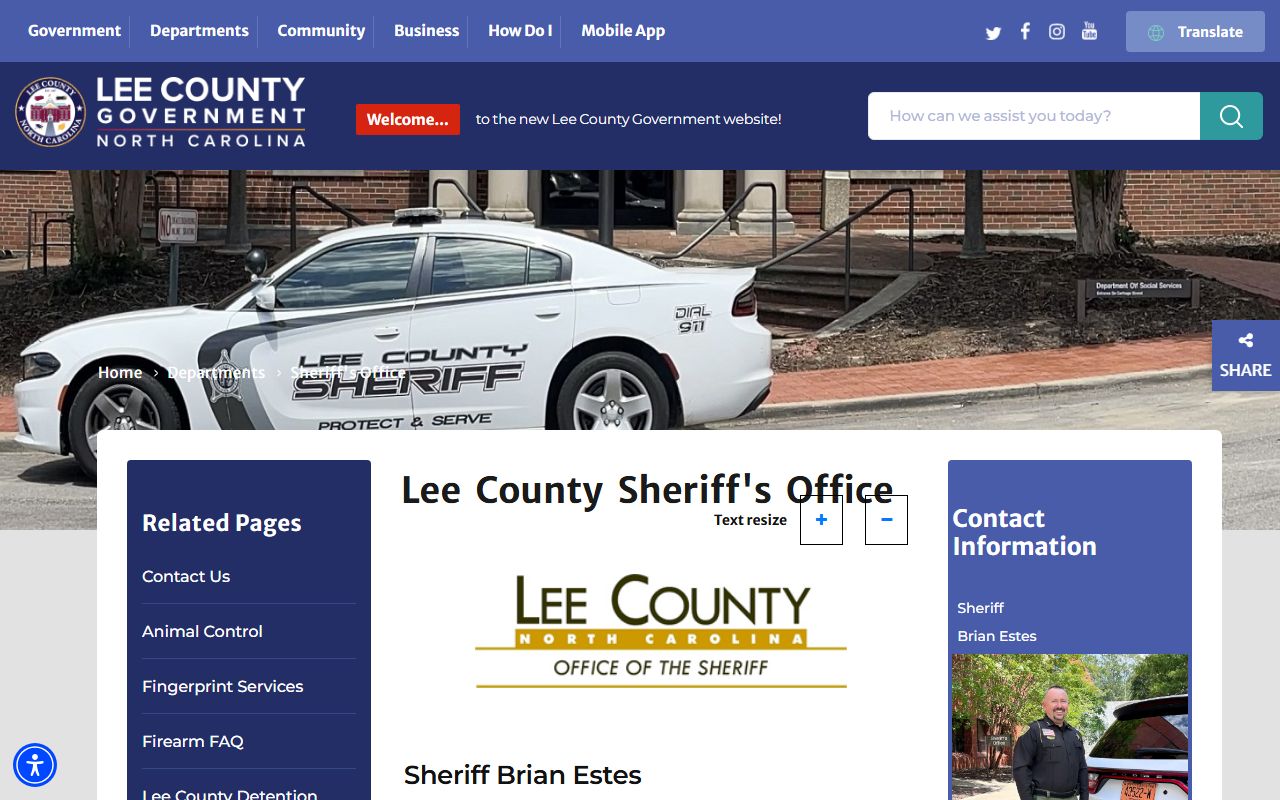
That sheriff source supports local arrest-record routing, but the formal court charge still has to be checked through court and clerk channels.
Find Lee County Arrest Records
No single Lee County source combines every arrest, booking, charge, disposition, and custody update. A practical search uses a chain. Start with the jail roster if the person may be in custody or recently released. Then use NC eCourts Portal for public charges and court events. Contact the Clerk of Superior Court for paper files, certified copies, and background-check handling. Contact the Sheriff's Office for sheriff records, recognizing that criminal investigation records have special access limits under North Carolina law.
- Search the Lee County Detention Facility current or released roster for booking or custody clues.
- Use the charges tab in the jail portal when the search is based on an offense description rather than a name.
- Search NC eCourts Portal by defendant name or record number and select Lee County when filtering is needed.
- Open the court case and read each charge line, current status, court date, and disposition if visible.
- Call the Clerk of Superior Court at (919) 718-6300 for paper files, copies, or unclear case status.
The jail search and the court search answer different questions. The jail can show current or released custody information, while the court record shows whether the State filed charges, amended them, dismissed them, or obtained a conviction. A person can have charges after arrest without being in current custody, and a jail record can update before a final court disposition appears.
Arrest to Charges Pathway
In North Carolina, the government prosecutes criminal cases through the district attorney. Lee County is in Prosecutorial District 12, which includes Harnett and Lee Counties. The District Attorney's Office is relevant to charging decisions, reductions, dismissals, plea negotiations, victim services, and subpoenas. It does not replace the Clerk of Superior Court as the public custodian of the court file.
The path often starts with an arrest warrant, citation, criminal summons, or magistrate order. A magistrate may issue arrest warrants and set bail. After that, charges are tracked by the court, and the State may later amend, reduce, dismiss, consolidate, or supersede them. Felony charges may move into Superior Court by indictment or other formal process. Misdemeanors and infractions generally remain in District Court unless appealed.
The assigned statute image comes from N.C.G.S. 132-1.4, the North Carolina law governing criminal investigation and intelligence records.
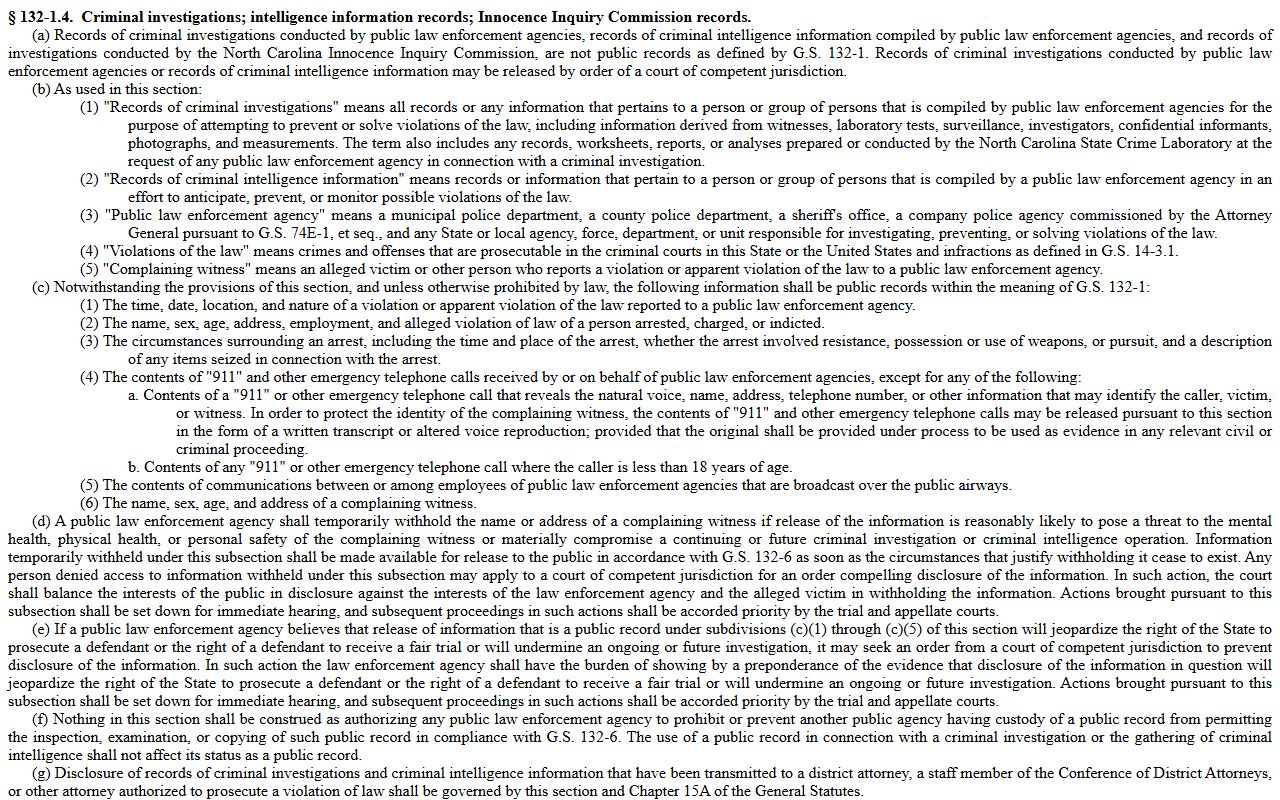
The statute matters because sheriff investigation files are not the same as returned criminal process or public court records.
Charging Documents After Arrest
Charging documents identify the offense the State is pursuing. A charge document can be more specific than a booking entry because it is tied to court process. It may also change after the first arrest record. The table below uses the three charging-document types required for the page, while keeping the Lee County focus on magistrate process, District Court, Superior Court, and District Attorney decisions documented in the research.
| Complaint or Process | Information | Indictment | |
|---|---|---|---|
| Filed by | Officer, complainant, or prosecutor through court process. | Prosecutor when allowed by procedure. | Grand jury process for felony-level prosecution. |
| Common use | Warrants, summonses, citations, magistrate orders, and early District Court charges. | Formal prosecutor-filed accusation where available. | Superior Court felony prosecution or superseding felony charge path. |
| What to check | Warrant or citation number, offense date, charge, bond, and next court date. | Exact offense and prosecutor-filed charge language. | Whether the indictment changed, added, or superseded earlier charges. |
Lee County Charge Status
Charge status is the current posture of each accusation, not a statement of guilt by itself. One arrest can produce several charge lines. Each charge may move at a different speed, and one charge can be dismissed while another results in conviction. Lee County court records should be read by charge, docket event, and final disposition.
| Status | What It Means |
|---|---|
| Pending | The charge remains open and has not reached final disposition in the visible court record. |
| Amended or reduced | The original charge changed, often after prosecutor review, plea negotiation, or a court ruling. |
| Dismissed | The charge was ended without a conviction on that charge, though other charges may remain. |
| Superseded | A later charging paper, such as an indictment, replaced the earlier charge record. |
| Disposed | The charge reached an outcome, such as guilty, not guilty, responsible, or dismissed. |
Jail Charge Search
The Lee County jail portal has Current and Released modes, an Inmates tab, a Charges tab, and a Days tab. The charges search box can search by charge description with autocomplete beginning at two characters. That makes it useful when the known fact is the offense description rather than the person's full name. It should not be treated as the final court outcome, because the jail grid research confirmed public grid fields such as full name, age, race, sex, and admit date, but did not confirm complete charge history, bond amounts, or individual profile drilldowns.
| Jail Portal Field | Use |
|---|---|
| Current / Released | Switches between current custody and released-inmate search mode. |
| Inmates tab | Searches by name using the inmate search box. |
| Charges tab | Searches by charge description when an offense is known. |
| Days tab | Searches recent entries by number of days, with a visible placeholder value of 5. |
| View all inmates | Opens the public inmate list for the selected mode. |
Charge vs Conviction
Arrest records and charge records are easy to misread. An arrest shows that a person was taken into custody or processed. A charge shows that a legal accusation was filed. A conviction means guilt was established by plea or verdict and judgment. Lee County court users should check the disposition for each charge before drawing conclusions.
| Charge | Conviction | |
|---|---|---|
| Meaning | A formal accusation in court records. | A guilty plea or guilty finding entered by the court. |
| Timing | Appears before final judgment. | Appears after plea, verdict, or other final criminal resolution. |
| Possible result | May be pending, dismissed, amended, reduced, or superseded. | May lead to sentence, probation, fines, costs, or restitution. |
Public Access and Restrictions
Public access depends on the record type. Clerk-maintained court records are generally open under N.C.G.S. 7A-109 unless prohibited by law. Criminal investigation records have separate rules under N.C.G.S. 132-1.4. Personal identifying information is protected under N.C.G.S. 132-1.10. Juvenile records are restricted under N.C.G.S. 7B-3000.
Expunged charges are also different from ordinary dismissed charges. The Judicial Branch explains that expunction can remove a criminal charge or conviction from a person's record and seal or destroy state records as ordered. Under N.C.G.S. 15A-145.5, some nonviolent misdemeanor and felony convictions may qualify only after waiting periods and required findings. The petition is filed in the county of conviction and served on the district attorney, who may object.
Important: Arrest and charge lookups are not FCRA consumer reports and should not be used for regulated screening decisions.