
Lee County Probate Court Role
In North Carolina, probate is handled by the Clerk of Superior Court. For Lee County, that means the Lee County Clerk of Superior Court serves as the Clerk of Superior Court as ex officio Judge of Probate. The Judicial Branch estates help page states that estate administration is handled through the courts, primarily in the office of the appropriate Clerk of Superior Court. The elected clerk and assistant clerks hold most estate hearings and perform probate functions.
Lee County probate records can include wills, letters testamentary, letters of administration, inventories, accountings, small-estate filings, summary administration, year’s allowance matters, guardianship-related special proceedings, and other estate documents. A contested will caveat can move before a Superior Court judge. That does not change the starting point: the Lee County Clerk of Superior Court is the probate filing and record office.
The state estates source is shown here: North Carolina estates and probate help.
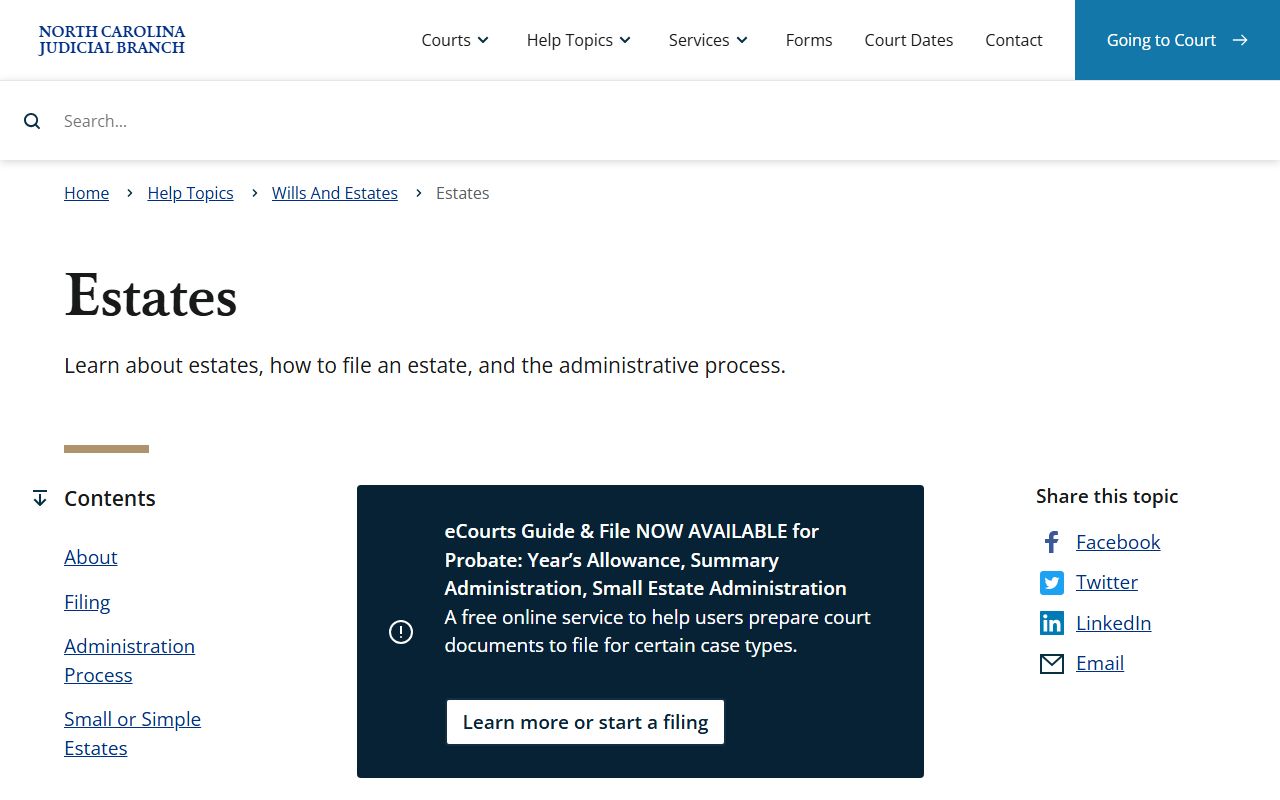
This Judicial Branch page confirms the probate role of the Clerk of Superior Court and the estate procedures used for Lee County probate matters.
Lee County Probate Terms
Probate terms can sound more formal than the work requires. The key point is that probate deals with a person's property and duties after death, and the clerk decides whether the filing route and representative authority are proper.
- Decedent
- A person who has died.
- Estate
- Money and property owned at death.
- Will
- A document made during life to direct inheritance; it has no legal effect until probated by a court.
- Probate
- Estate administration generally, and also the process of deciding whether a purported will is valid.
- Personal representative
- An executor named in a will or an administrator appointed by the clerk.
- Intestate
- Dying without a valid will.
Search Lee County Probate Records
Lee County estate users can search the NC eCourts Portal for case information, using Lee County as the location filter where needed. The research says estate users should search by decedent or estate name, party name, case number or record number, Lee County location, case type if available, and file-date range. The Portal's static text did not expose a specific estate dropdown list, so the field table should not claim an unverified estate-only menu.
Online search is only one channel. Estate files can be viewed at the clerk's office in the county where the estate is located, subject to restrictions. The Clerk of Superior Court can also provide copies for a fee. For older files, paper documents, or certified copies, the Lee County courthouse remains the more reliable probate records route than a general web search.
| Search Field | Use for Probate | Verified Note |
|---|---|---|
| Record number or case number | Direct lookup when known. | Portal accepts record-number searches. |
| Decedent or estate name | Find an estate by the person who died. | Use name search and Lee County filters. |
| Party name | Find related parties where public access permits. | Party-name search is part of Smart Search. |
| Location | Limit results to Lee County. | Portal location options include counties. |
| File date range | Narrow older or newer estate filings. | Smart Search has file date start and end filters. |
Lee County Probate Guide & File
The Judicial Branch estates page says eCourts Guide & File is available for probate Year’s Allowance, Summary Administration, and Small Estate Administration. That is a significant access channel for people who need to prepare probate forms without beginning from a blank PDF. Guide & File does not replace the clerk's review or all estate filing duties, but it can help organize the correct form route for simpler probate matters.
Lee County users should match the tool to the estate type. Year’s Allowance is different from Summary Administration, and both are different from full estate administration. A person who is unsure whether assets pass outside probate, whether a will must be probated, or whether a small estate route applies should contact the Lee County Clerk of Superior Court or use official Judicial Branch estate materials before filing.
- Decide whether property may pass outside probate through beneficiary designation, survivorship, trust, or another nonprobate transfer.
- If probate is needed, identify whether the decedent was domiciled in Lee County or whether the estate belongs there.
- Locate the original will if one exists, because a will has no legal effect until probated.
- Use Judicial Branch forms or Guide & File for Year’s Allowance, Summary Administration, or Small Estate Administration where appropriate.
- File the opening documents with the Clerk of Superior Court and follow clerk instructions for qualification, notices, inventory, accounting, and copies.
Lee County Probate Contact
The probate contact is the Lee County Clerk of Superior Court. The courthouse is the same local access point for Superior Court, District Court, public terminals, paper court files, and estate records. The official contact directory lists the main Clerk of Superior Court number and separate divisional contacts, including estates, but the research says masked email text should be handled by linking to the official directory rather than reproducing uncertain addresses.
Lee County Clerk of Superior Court
1400 S Horner Blvd
Sanford, NC 27330
(919) 718-6300
Monday-Friday, 8:00 AM-5:00 PM
Lee County Probate Fee Notes
The research did not locate a Lee County-specific probate fee schedule or a sample estate-record drilldown in accessible official text. Because of that gap, the fee table should not invent filing charges, letters fees, or certification amounts. The verified rule is that clerk staff can provide copies for a fee, and official Judicial Branch fee schedules should be checked when exact statewide fees are needed.
| Probate Item | Verified Lee County Research Result |
|---|---|
| Estate filing fee | Exact Lee-specific amount not located in accessible official text. |
| Small estate or summary administration fee | Exact Lee-specific amount not located in accessible official text. |
| Certified probate copy | Fee applies, but exact Lee-specific amount was not located. |
| Paper file review | Available at the clerk's office, subject to restrictions and office procedures. |
| Guide & File forms | Available for Year’s Allowance, Summary Administration, and Small Estate Administration per Judicial Branch estates guidance. |
Lee County Probate Recordkeeping
North Carolina law recognizes clerk-maintained records, files, dockets, and indexes. The research cites N.C.G.S. 7A-109 for court recordkeeping and public inspection unless another law prohibits access. Estate indexes and files fit within the clerk's court-record role, but probate records can still include restricted information.
The official recordkeeping statute source is shown here: N.C.G.S. 7A-109 court recordkeeping statute.
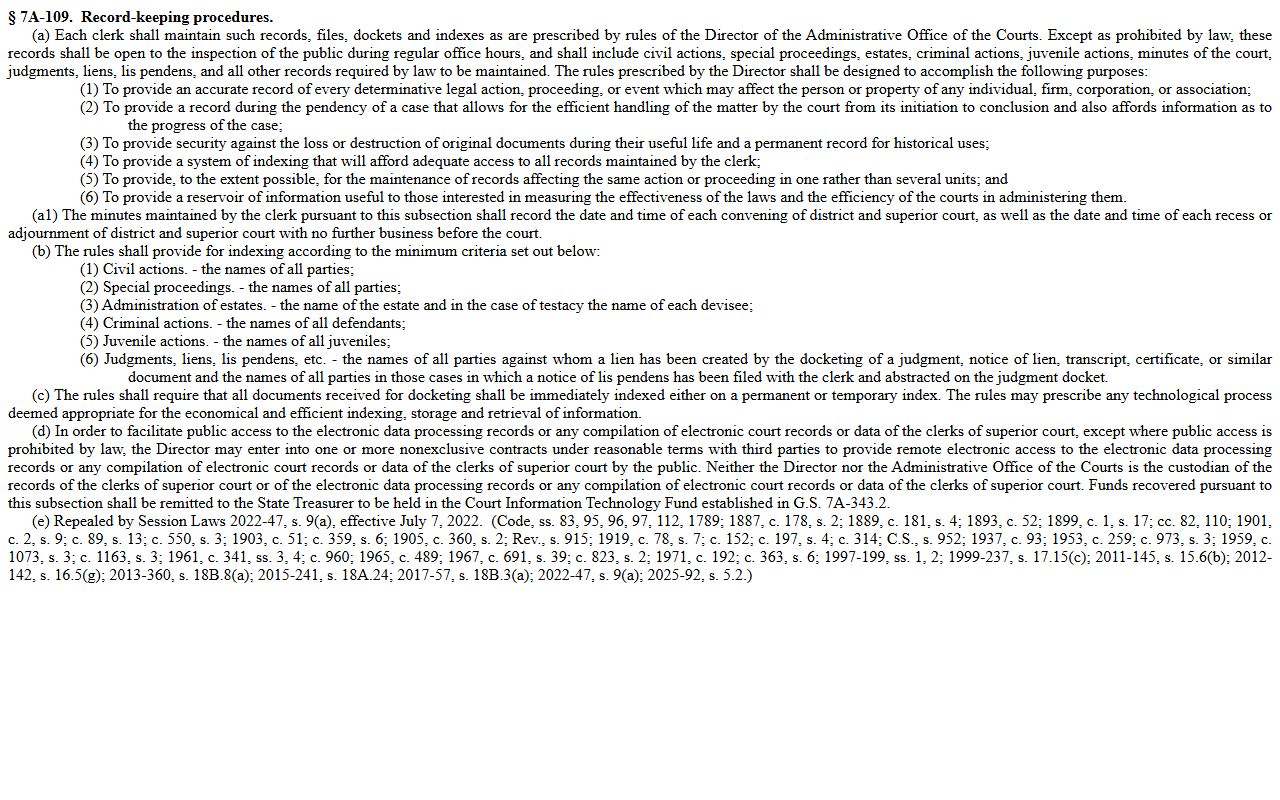
This statute supports public inspection of clerk-maintained probate indexes and files while preserving limits imposed by confidentiality laws or court orders.
Restricted Lee County Probate Records
Probate records are not all alike. Routine estate filings may be available through Portal, public terminals, or paper-file review, but guardianship-related materials, mental health records, juvenile information, sealed filings, financial account numbers, Social Security numbers, and other personal identifiers can be restricted or redacted. Special proceedings also may involve sensitive property or family details.
For a related civil case, partition, guardianship, or estate dispute, use the clerk's access channels and ask for the specific public file or copy needed. Marriage certificates remain with the Register of Deeds, while divorce judgments are court records. When a probate issue overlaps with a family record, the office that holds the record depends on the record type, not just the family relationship.