
No Public Active-Warrant Database
Lee County did not have an official public online active-warrant search confirmed in the sources inspected. That is the most important starting point. A Lee County warrant lookup should not be built around a third-party list or an assumed sheriff database. The verified path is a fallback chain: magistrate or court process for warrant questions, the Clerk of Superior Court for related court files, the Sheriff's Office for law-enforcement routing, the jail roster for custody after arrest, and VINELink for custody notification rather than warrant search.
North Carolina magistrates can issue arrest warrants and set bail. Lee County Magistrates are listed at (919) 718-6319 in the official court contact directory. The Clerk of Superior Court is listed at (919) 718-6300. The Sheriff's Office main number is (919) 718-4560, and the crime tip line is (919) 718-4577. Use 911 for emergencies. For nonemergency warrant questions, callers should expect procedural routing rather than legal advice.
Lee County Warrant Fallback Chain
A careful warrant search uses more than one official source because each office sees a different part of the record. A warrant may exist before arrest, after a missed court date, after a probation issue, or as a returned criminal process in a court file. A jail record may confirm that a warrant led to arrest, but it does not prove that all warrant matters are resolved.
- Call the Lee County Sheriff's Office at (919) 718-4560 for law-enforcement routing on nonemergency warrant questions.
- Call Lee County Magistrates at (919) 718-6319 for procedural questions about magistrate-issued process and bail.
- Search NC eCourts Portal for a related criminal case by defendant name, record number, charge, or Lee County location filter.
- Call the Clerk of Superior Court at (919) 718-6300 for case-file access, court dates, paper records, or copy questions.
- Search the Lee County jail current and released roster if the warrant may already have resulted in arrest.
- Use VINELink for custody or victim notification, not as a complete active-warrant database.
The assigned VINELink source image supports the custody-notification part of the warrant fallback chain.
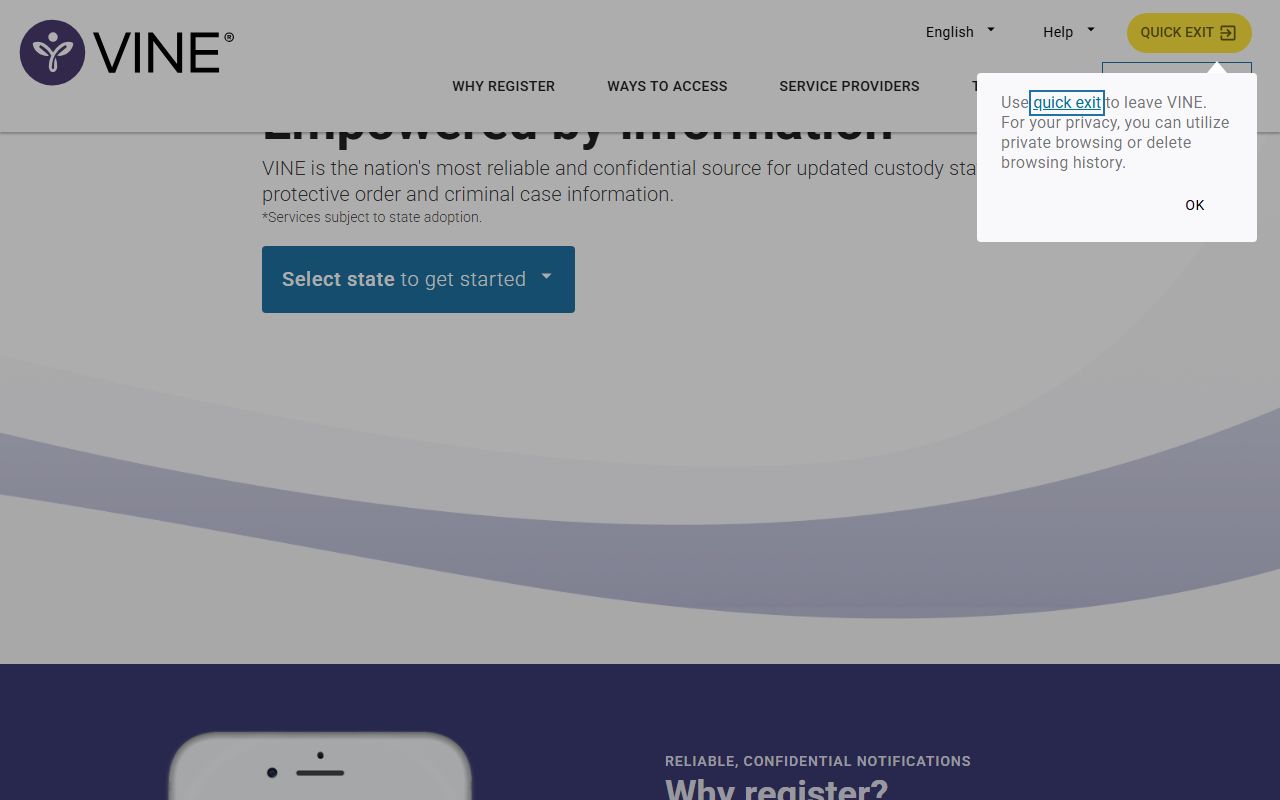
VINELink is useful after custody information exists, but it should not be described as a complete Lee County active-warrant search.
Types of Lee County Warrants
Warrant language can vary by court context. The public often uses "warrant" for many processes, but the court record may use more precise terms. Lee County criminal cases can involve arrest warrants, bench warrants or orders for arrest, search warrants, fugitive holds, and failure-to-appear consequences. Some warrant records become public when returned or filed, while others may remain sealed or restricted.
- Arrest warrant - A judicial order authorizing law enforcement to arrest a person based on criminal process.
- Bench warrant or order for arrest - Often follows a missed court date, probation violation, or contempt issue.
- Search warrant - Authorizes a search; returned search warrants can become public court records unless sealed.
- Fugitive warrant or hold - May appear as a hold or transfer issue in jail release processing.
- Failure to appear - Can create added court consequences, possible order for arrest, and license consequences in traffic matters.
Lee County Warrant Search Fields
Because no official public active-warrant database was confirmed, there is no verified Lee County active-warrant search-field table to render. The practical fields are the ones a person uses when checking related court, sheriff, magistrate, and jail channels. These fields help route the question without implying that a public warrant search portal exists.
| Field or Detail | Where It Helps | Notes |
|---|---|---|
| Full name | Sheriff, magistrate, clerk, Portal, jail roster | Use legal name and known aliases when asking official offices. |
| Date of birth | Official phone or in-person checks | Helps distinguish people with similar names, subject to office policy. |
| Case or record number | NC eCourts Portal and clerk | Portal accepts record-number searches and wildcard record-number searches. |
| Charge or offense | Portal, jail charge search, clerk | Useful when the offense is known but the case number is not. |
| Court date | Clerk, Portal hearing search, jail update context | Missed court dates can be tied to orders for arrest or failure-to-appear consequences. |
What Warrant Records Show
The researched warrant field inventory identifies categories that may appear through Portal, court records, jail records, or official office checks. The key limitation remains the same: no confirmed public active-warrant database means warrant status must be verified through official channels. A related criminal case can show charges and court events, but it may not prove whether every warrant has been served, recalled, cleared, or sealed.
| Field | Public Availability Note |
|---|---|
| Defendant name | Searchable through Portal if tied to a public case. |
| Case number or record number | Portal accepts record-number searches for related cases. |
| Charge or offense | May appear in the criminal case or jail record. |
| Issuing authority | May be a magistrate or judge depending on the warrant type. |
| Bond or release condition | Magistrates set bail; jail release can depend on bond or court order. |
| Court date | Jail court dates update within 48 business hours after the detention facility receives them. |
| Warrant status | No official public active-warrant database was confirmed; call sheriff, magistrate, clerk, or counsel. |
| Sealed warrant | May not be public until unsealed or returned, depending on law or order. |
Returned and Sealed Warrants
North Carolina law treats criminal investigation records differently from ordinary public court records. Returned warrants and certain criminal process records can become public court records unless sealed. Search warrants may also have delayed or limited access if disclosure would affect an investigation, reveal confidential information, or conflict with a court order. Juvenile matters carry separate restrictions.
The assigned statute image comes from N.C.G.S. 7B-3000, which covers juvenile record restrictions.
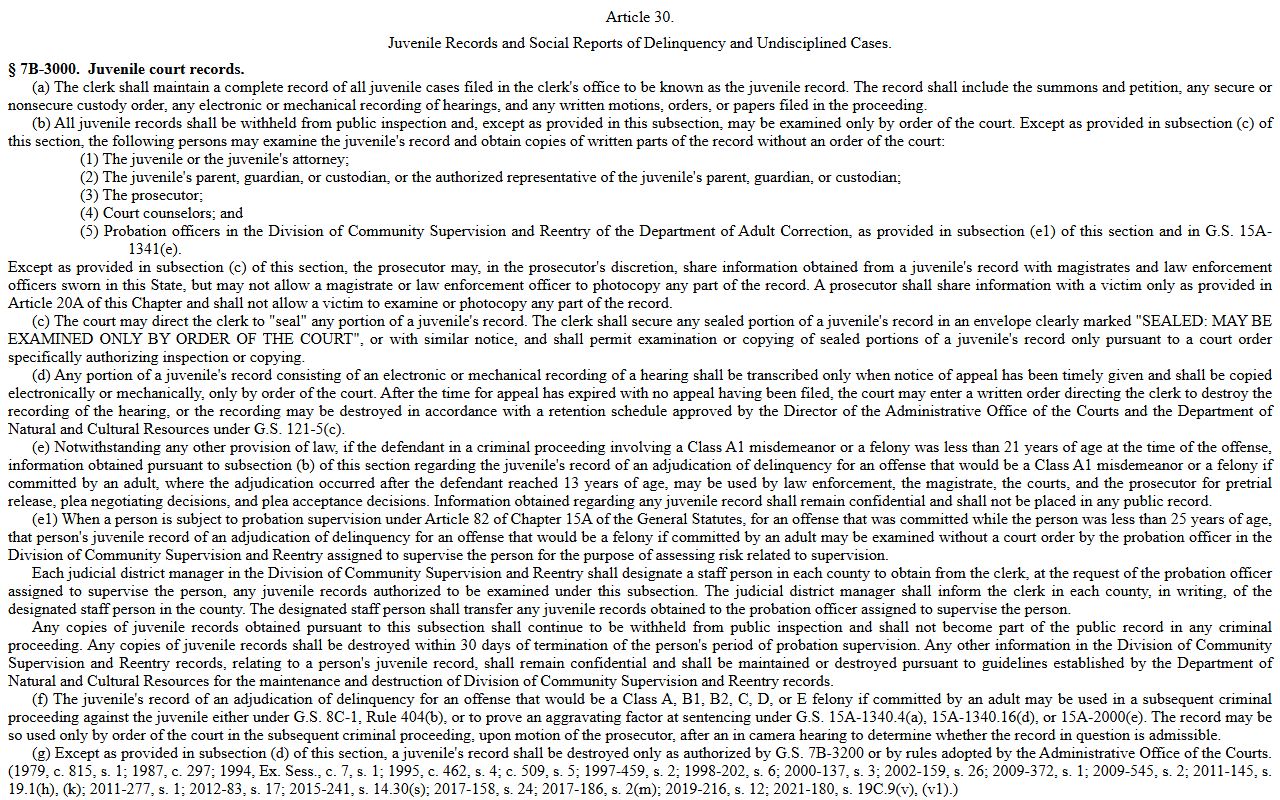
That restriction is one reason a warrant-related court search may return limited information even when official records exist.
Resolving a Lee County Warrant
Anyone who may have an outstanding Lee County warrant should verify through official channels before taking action. Third-party warrant websites may be incomplete or stale. Official confirmation may come from the Sheriff, magistrate, clerk, an attorney, or a related court record. If the matter stems from a missed Lee County court date, the clerk and Portal are especially important because the warrant may be tied to an open criminal, traffic, or probation matter.
- Confirm the record through the sheriff, magistrate, clerk, or an attorney.
- Do not rely only on third-party warrant sites or old search-result snippets.
- If the issue is a missed court date, check Portal and call the Clerk of Superior Court at (919) 718-6300.
- Consult a criminal defense attorney or ask the court about appointed-counsel procedures before appearing if arrest is likely.
- Ask official staff where to appear and what identification, bond resources, or paperwork may be needed.
- After resolution, verify the court, jail, or Portal update because clearance may not be immediate.
Important: Do not drive to resolve a warrant if license status, bond status, or arrest risk is uncertain.
Tips, App, and Limits
The Lee County Sheriff's Office publishes a crime tip line at (919) 718-4577. The Sheriff's Office page also warns that the office does not monitor Facebook for assistance and asks people to call the office to report a crime or speak with law enforcement. The official Lee County NC Linked app is a county government app with social media, contacts, payments, Register of Deeds access, GIS, tax bill inquiry, bids, news, maps, and department information. The research did not confirm an app-only warrant lookup.
For warrant records, the honest rule is simple: use official offices and do not invent an active search where none was verified. Sheriff, magistrate, clerk, Portal, jail, and VINELink channels each answer a different part of the question.